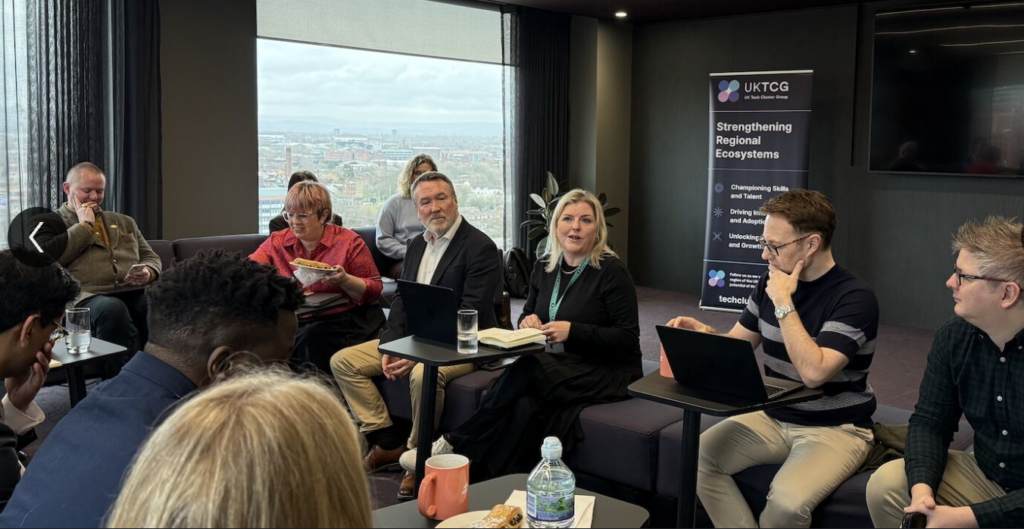
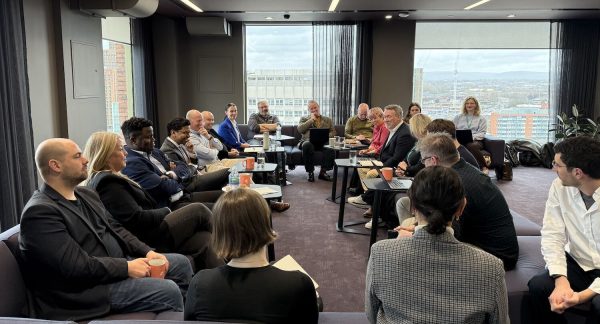
In March, leaders from across the UK’s tech ecosystem came together for a roundtable on the Regional Tech Booster, joined by AI Minister Kanishka Narayan. The session brought together delivery partners from the programme’s Catalyst pilots to reflect on progress, share insights and explore how government and industry can build on the momentum created.
Chaired by Katie Gallagher, Managing Director of Manchester Digital and Chair of the UK Tech Cluster Group, the discussion highlighted the strength of a place-based approach to ecosystem development. Each Catalyst pilot has been designed and delivered locally, responding to the specific needs and opportunities within its region, from unlocking investment and supporting founders, to strengthening supply chains and accelerating AI adoption.
The early impact of the programme is already clear. More than 500 tech businesses and ecosystem organisations have engaged with Regional Tech Booster activity to date, alongside 85+ events delivered across the UK. The programme has also facilitated 143 investor pitch meetings, more than double its original target, demonstrating strong demand from both founders and investors to connect beyond traditional hubs.
The roundtable brought these numbers to life through real examples of impact.
In South Yorkshire, Sheffield Digital’s Pathways Off the Plateau pilot focused on established tech businesses that had stalled in their growth journey. By bringing founders together in structured cohorts, the programme helped businesses re-engage with growth, access new expertise and rebuild momentum. Participants reported renewed confidence, stronger peer networks and a clearer path to scaling.
In Sussex, a pilot exploring quantum supply chains uncovered immediate commercial opportunities by connecting local businesses. Companies developing quantum technologies were able to identify specialist suppliers within their own region – in some cases replacing international sourcing with local partnerships. This not only reduces friction and cost but strengthens the foundations of a regional deep tech cluster.
In the West Midlands, a programme supporting first generation immigrant founders provided structured access into the UK innovation ecosystem. Through a six-month cohort, founders were introduced to industry partners, universities and investment pathways. The programme supported 30 ventures, with over half progressing to pitch stage and several entering discussions with universities around IP collaboration – opening up new routes to growth.
Other pilots demonstrated the role ecosystem organisations play in broadening participation. In Northern Ireland, the Activate AI programme enabled businesses to adopt AI tools in practical, productivity-focused ways. The programme reached a diverse cohort, with over 60% of participants based outside Belfast and more than half women, helping extend access to innovation support beyond traditional centres.
In Leeds and Lancashire, startup-focused pilots worked with early stage founders and students, many at idea stage, helping them develop business models, test ideas and build entrepreneurial confidence. Importantly, these programmes are not only creating new startups, but also equipping individuals with skills that feed into the wider economy.
Alongside these place-based interventions, the programme has also made progress in strengthening investment connectivity across regions. By improving investor readiness, curating more targeted engagement opportunities and leveraging the collective networks of UK Tech Cluster Group members, the programme is helping reduce friction between founders and capital, while also unlocking wider commercial opportunities.
Speaking at the roundtable, Minister Narayan reinforced the government’s commitment to spreading opportunity across the UK. He highlighted the importance of regional strengths, local leadership and practical insights in shaping future policy, particularly as the UK looks to build global leadership in areas such as AI and deep tech.
The discussion made one thing clear: the UK’s regional tech ecosystems are not short on ambition or capability. The success of the Catalyst pilots shows what can be achieved when local organisations are empowered to lead.
The next step is to build on this foundation – ensuring that the momentum, partnerships and learning generated through the Regional Tech Booster can continue to drive long-term growth across the UK.